Since 1896, NYK has held a long-lasting relationship with Australian society. First providing conventional shipping services prior to the introduction of the container, as shipping evolved over the decades and cargo-specific vessels were engineered, built, and bought into operation. NYK has been at the forefront of this evolution providing services for all vessel types to/from Australia since 1896. The NYK RORO shipping service has been operating in Australia since the 1970s.
HISTORY
Born of the merger of Mitsubishi Mail Steamship Company and Kyodo Unyu Kaisha, NYK resultantly expanded its business from the seas of Asia to the oceans of the world under a Nibiki flag featuring two thick red lines on a white background to symbolize the union of the two companies from which NYK arose.
1885
Mitsubishi Mail Steamship Company and Kyodo Unyu Kaisha merged on September 29 to form Nippon Yusen Kaisha (NYK); the new company inaugurated operations on October 1 with a fleet of 58 steamships.
1886
Liner service began between Nagasaki, Japan, and Tianjin, China.
1893
Japan’s first long-distance liner service began on Bombay route.
1896
London branch opened.
Liner service began on European, Seattle, and Australian routes.
1911
Calcutta liner service began.
1914
Tokushima Maru became the first Japanese ship to pass through the newly completed Panama Canal.
1916
Liner service to New York via Panama Canal began.
1917
Liner service to east coast of South America began.
1920
New York branch opened.
1923
Departure of Nagasaki Maru inaugurated Japan-China (Nagasaki-Shanghai) Rapid Express Service.
1926
Acquired Dai-ni Toyo Kisen Kaisha, gaining routes to San Francisco and the west coast of South America.
1929
Distinctive twin red stripes on white background became official funnel mark for NYK vessels.
1939
Acquired Kinkai Yusen Kaisha Ltd.
1942
Three NYK vessels – Asama Maru, Tatsuta Maru, and Kamakura Maru – provided transport for exchange of U.S., British, and Japanese diplomats.
During World War Ⅱ, NYK tragically lost its two key assets – ships and crew. Following the war and throughout a period of high economic growth, the company embarked on the development and use of specialized carriers to support Japan’s economic growth.
1945
Only 37 vessels, totalling 155,469 gross tons, remained after World War ll.
(185 vessels totalling 1,131,424 gross tons lost in the war)
1951-1957
Main liner services resumed.
1959
Group’s first crude oil tanker, Tamba Maru, launched.
1960
Group’s first iron ore tanker, Tobata Maru, launched.
1961
Cargo-passenger ship, Hikawa Maru, moored in the port of Yokohama, where it is opened to the public.
1962
World’s first large LPG carrier, Bridgestone Maru, launched.
1964
NYK and Mitsubishi Shipping Co. Ltd. merged to form a newly enlarged NYK Group.
World’s first wood-chip carrier, Kure Maru, launched.
1968
Hakone Maru, Japan’s first fully containerized ship, began service on new California route.
1969
Near seas and domestic coastal services transferred to Kinkai Yusen Kaisha Ltd.
Container service to Australia began.
Group’s first car/bulk carrier, Toyota Maru No. 5, launched.
NYK Line (Hong Kong) Ltd. and NYK (Thailand) Co. Ltd. established.
1970
Container service to the west coast of North America began.
Group’s first car carrier, Jintsu Maru, launched.
1971
Container service to Europe began.
1972
Container service to the east coast of North America began.
1974
Group’s first container terminal operations commenced at Oi in the port of Tokyo.
1978
Nippon Cargo Airlines Co. Ltd. (NCA) established.
1979
Container service to Persian Gulf began.
1980
Australia-Malaysia-Persian Gulf container service began.
1981
Container service to the west coast of South America began.
Container service to South Africa began.
1983
NYK Line (Singapore) Pte. Ltd. established.
LNG shipments from Indonesia to Japan began.
1986
Group’s first long-term management vision, “NYK 21” announced.
1988
NYK Line (North America) Inc. established.
Hong Kong Logistics Centre completed.
1989
NYK Line (Europe) Ltd., NYK Bulkship (USA) Inc., and NYK Bulkship (Europe) Ltd. established.
Logistics centres established in Bangkok, Los Angeles, and Sydney.
1990
Luxury cruise ship Crystal Harmony began service as Group reenters cruise business.
1991
Acquired Nippon Liner System Co. Ltd.
Los Angeles and Oakland container terminals opened.
Laem Chabang (Thailand) Container Terminal opened.
Asuka, Japan’s largest luxury cruise ship, began service.
1992
Kaohsiung (Taiwan) Container Terminal opened.
1993
First Japan-registered double-hull tanker, Takamine Maru, launched.
1994
NYK Line (Deutschland) GmbH, NYK Line (Benelux) B.V., and NYK Line (Sverige) AB established.
1995
NYK Line (China) Co. Ltd. established.
1996
New container services offered through the Grand Alliance commenced on the North America – European routes.
LNG shipments from Qatar to Japan began.
1997
Diamond Grace tanker accident occurred in Tokyo Bay.
1998
Acquired Showa Line Co. Ltd.
Introduced NAV9000, a rigorous self-imposed safety management system.
1999
Liner Division and Car Carrier Division obtained ISO 9002 certification.
2002
NYK (including chartered fleet) obtained ISO14001 certification, world’s first for a shipping company.
2003
NYK 21 “Forward 120,” the company’s medium- to long-term group management vision, announced.
NYK Maritime Museum opened in the renovated Yokohama Yusen Building.
NYK Logistics (Europe) Ltd. and NYK Logistics (Asia) Pte Ltd. established.
Group invested in Dalian Port RORO terminal.
2004
All logistics subsidiaries rebranded as “NYK Logistics.”
MTI (Monohakobi Technology Institute) established for the development of new technology.
2005
New medium-term management plan, “New Horizon 2007,” announced.
Nippon Cargo Airlines (NCA) became a consolidated subsidiary of NYK.
Endorsed and declared the support for the United Nations Global Compact (UNGC).
Luxury cruise ship Asuka II launched.
2007
NYK-TDG Maritime Academy opened in the Philippines.
NYK Group Values (The 3 I’s – integrity, innovation, and intensity) announced.
2008
“New Horizon 2010,” the company’s new medium-term management plan, announced.
2009
Exploratory design for NYK Super Eco Ship 2030 released.
Group participated in project for ultra-deepwater drillship chartered by Petrobras.
2010
Group entered offshore shuttle tanker business by purchasing interest in Knutsen Offshore Tankers AS.
Yusen Logistics established to integrate the NYK Group’s logistics.
2011
New medium-term management plan, “More Than Shipping 2013,” announced.
Group participated in FPSO business (ultra-deep pre-salt layer off Brazil).
2012
NYK’s Ship Energy Efficiency Management Plan (SEEMP) became the first in the world to be certified by ClassNK.
Members of the Grand Alliance and The New World Alliance created the G6 Alliance and cooperate to form new Asia-Europe container services.
Group jointly participated in Wheatstone LNG project in Australia.
2013
NYK-Hinode Line Ltd. and NYK Global Bulk Corporation merged to form NYK Bulk & Projects Carriers Ltd.
2014
New medium-term management plan, “More than Shipping 2018,” announced.
2015
Japan’s first LNG-fueled tugboat, Sakigake, launched.
2016
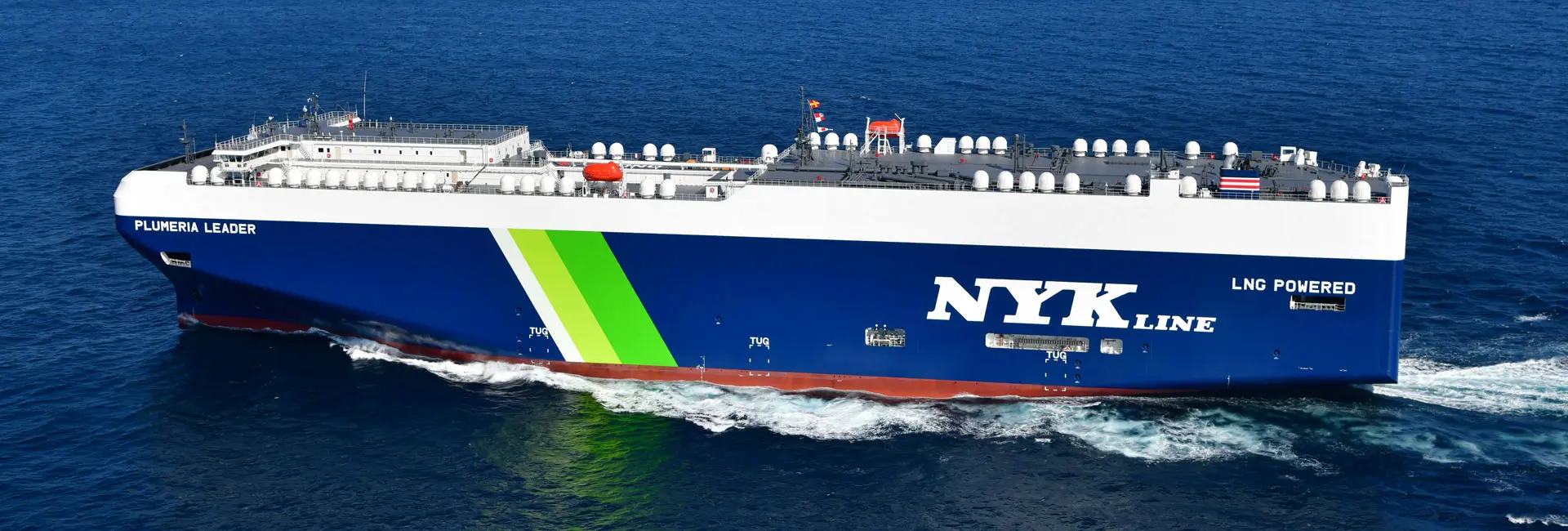
World’s first LNG-fueled pure car and truck carrier (PCTC) delivered.
2017
The new integrated container shipping company (Ocean Network Express Pte. Ltd.) established.
Full acquisition of Yusen Logistics Co., Ltd.
ENGIE Zeebrugge, the world’s first LNG bunkering vessel, launched.
2018
New medium-term management plan, “Staying Ahead 2022 with Digitalization and Green,” announced.
The new integrated container shipping company (ONE) started operation.
Exploratory design for NYK SUPER ECO SHIP 2050 released.
2019
World’s first Maritime Autonomous Surface Ships trial conducted.
2020
Establishment of framework for ESG management.
MarCoPay Inc. realizes world’s first onboard use of digital currency.
Japan’s first LNG-fueled pure car and truck carrier(PCTC)delivered.
2021
The NYK Group ESG Story issued.
First NYK-TDG Maritime Academy graduate attains rank of NYK captain.
Target of net-zero emissions by 2050 for oceangoing businesses announced.